Next.js deployment

Deploy a Next.js app from GitHub.

Turn a supported Next.js repository—whether you built it by hand or with an AI coding tool—into a working HTTPS URL. RunYour.App analyzes one app, builds the exact revision, starts one Node web process, and verifies the platform route.

Deploy with GitHub

Free during the public beta. No credit card required.

Check exact Next.js support
Verified live

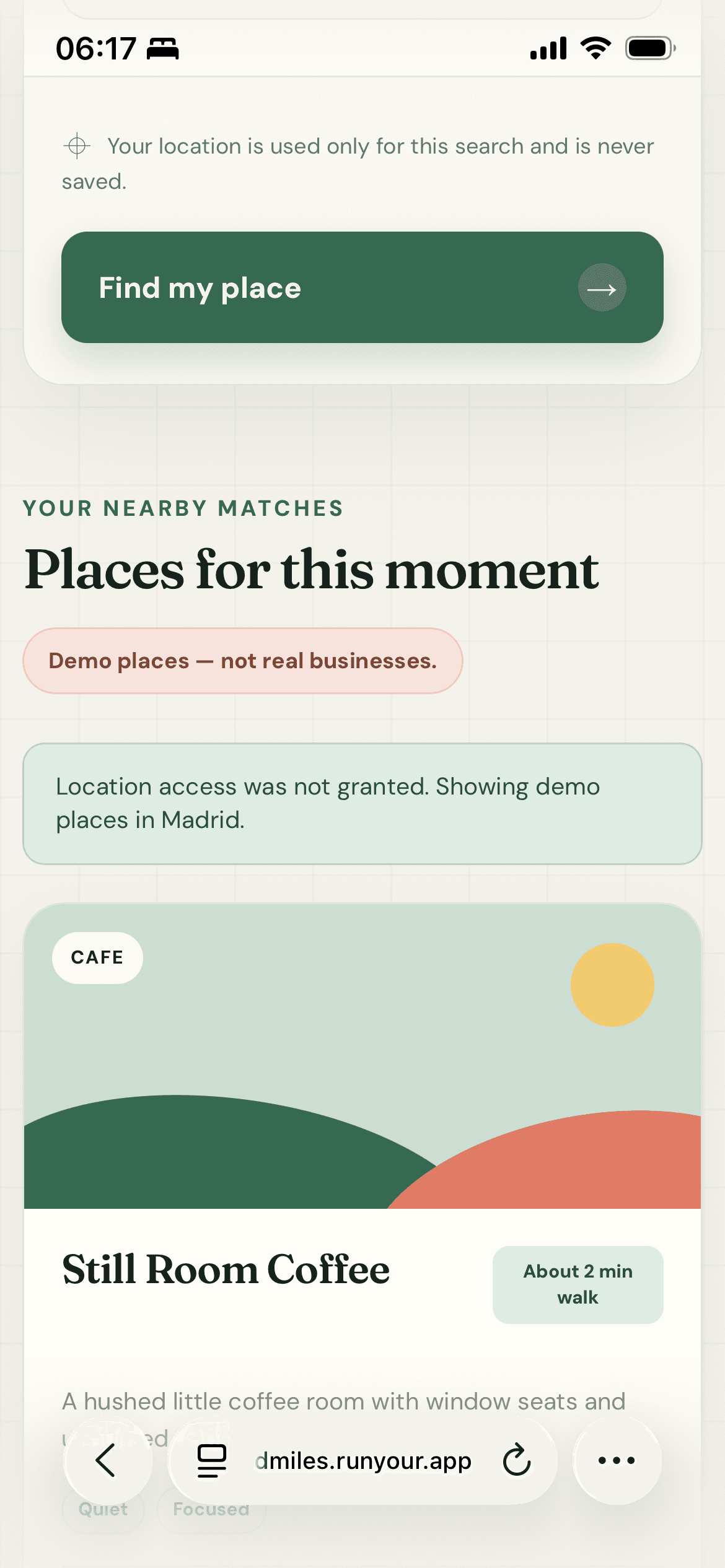
MoodMiles: an exact Next.js + Supabase commit built, started, routed over HTTPS, and browser-checked with live Supabase results.

See verification proof
  • Next.js + React signature
  • One web process and replica
  • npm, Bun, pnpm lockfile paths
  • Exact revision and HTTPS route

Supported shape

One detected app, one Node runtime.

Support is based on the complete detected repository shape—not the Next.js name alone. One deployable app root may be nested, but multi-app and multi-service graphs are not implied.

Read the exact node-ssr-v1 profile for the authoritative commands and admission rules.

  • One detected Next.js + React application root and one web component.
  • A package.json plus a matching admitted lockfile for npm, pnpm, or Bun.
  • Existing build and start scripts that match the published package-manager contract.
  • A non-interactive locked install and production build.
  • One Node web process listening on the expected platform socket and port.

npm

package-lock.json

Bun

bun.lock

pnpm

pnpm-lock.yaml

Public values and runtime secrets stay separate.

Declared NEXT_PUBLIC_* values are non-secret build inputs. Next.js can embed them in browser assets, so URLs and publishable client keys must be treated as public.

Runtime-only server values may be secret and are bound to the deployed revision. Secret build-time variables are rejected; never place a Supabase service-role key or other server credential in a browser-visible variable.
Build inputs belong to an exact revision.

A public value used during the verified build cannot be changed in production without a new build and check. Deployment-check settings and live-app settings remain separate; this does not create a user-facing preview environment.

Verification boundary

A verified deployment is not a fully tested application.

RunYour.App verifies

  • Repository analysis and the selected exact commit.
  • Locked dependency installation and production build.
  • Node process startup and the expected TCP socket and port.
  • Platform route, hostname certificate, and deployed revision.

You still verify

  • Individual pages, API routes, and server handlers.
  • Server Actions, authentication flows, and business logic.
  • External-service behavior, data, and provider readiness.
  • Anything beyond the published framework-level runtime check.

Public-beta limits

Design for one replaceable process.

These limits are part of the current contract, not hidden footnotes. Review current platform status.

  • One web process and one replica; custom replica counts are unavailable.
  • In-memory cache and ISR state are not shared or durable; restart loses ephemeral cache.
  • Releases use recreate cutover, not rolling revisions.
  • An old tab can hold a stale Server Action ID and may need a reload or explicit error.
  • Workers, cron jobs, persistent storage, and unsupported multi-service graphs are outside the profile.
  • Deploy-on-push, user-facing previews, and first-class customer custom domains are unavailable.

Next.js with Supabase

Keep the backend you already operate.

A supported Next.js app can connect to an existing Supabase project. Supabase continues to operate Postgres, Auth, Storage, Realtime, and other provider services; RunYour.App does not create, move, or host that project.

Migrations and RLS changes remain manual. Provider readiness and application deployment verification are reported as separate outcomes.

The boundary stays explicit

  • Public browser keys remain public NEXT_PUBLIC_* values.
  • Server credentials stay in runtime-only server configuration.
  • Database schema, migrations, and RLS remain under your control.
  • A successful app deployment does not imply every Supabase workflow passed.

Real deployment proof

MoodMiles: one exact Next.js + Supabase result.

This record proves the published revision below—not every Next.js version or feature. The platform verified its build, Node process, port, route, certificate, and revision. A separate browser check loaded this exact app and rendered results from its public Supabase nearby-search call.

See the detected plan before you deploy.

Connect GitHub, choose a repository and branch, review the detected build and missing settings, fix blockers, then deploy the exact revision you selected.